
Minority Misleading Ghanaians Over US$17bn DGPP Loss – Inusah Fuseini
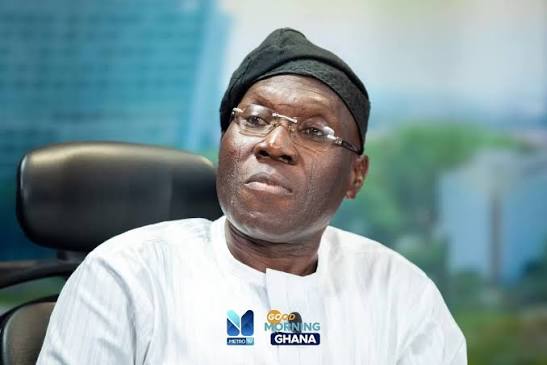
Former Member of Parliament Alhaji Inusah Fuseini has accused the Minority in Parliament, particularly Minority Leader Alexander Afenyo-Markin, of misleading Ghanaians over the reported US$1.7 billion cost associated with the Bank of Ghana’s Domestic Gold Purchase Programme (DGPP).
According to Mr Fuseini, the International Monetary Fund (IMF) report being cited by the Minority does not state that the Ghana Gold Board (GoldBod) caused the US$1.7 billion loss.
Speaking on the Kyzz FM Morning Show, the former legislator described attempts to directly link the figure to GoldBod and its Chief Executive Officer, Sammy Gyamfi, as what he called “dubious propaganda”.
He argued that the Minority’s interpretation risks creating a misleading public perception about GoldBod and its leadership.
“We must be honest in our conversations in this country. We should speak the truth boldly and fearlessly,” he said.
Mr Fuseini explained that GoldBod receives agreed margins and fees from the Bank of Ghana for services provided under the programme.
He said GoldBod is entitled to a 0.5 percent margin when it purchases gold on behalf of the central bank under a contractual arrangement.
According to him, the arrangement predates GoldBod, noting that the Precious Minerals Marketing Company (PMMC), which previously performed similar functions, operated under a comparable arrangement.
He therefore questioned the basis for attributing the entire US$1.7 billion figure to GoldBod.
Parliament must examine the wider programme
Mr Fuseini said the matter, having been referred to Parliament, should be examined within the broader operations of the Domestic Gold Purchase Programme rather than focusing solely on GoldBod.
He explained that Parliament could, under its Standing Orders, establish an ad hoc committee to investigate the technical and operational aspects of the programme.
Such a committee, he said, could examine the implementation of the DGPP from 2021 to date, determine how the costs were incurred and establish whether the US$1.7 billion should properly be classified as losses or operational costs.
He stressed that the investigation should involve the wider programme and all relevant institutions.
DGPP should be assessed beyond US$1.7bn
Mr Fuseini also argued that the assessment of the Domestic Gold Purchase Programme should not be based solely on the US$1.7 billion figure.
He said the programme must also be considered in the context of its broader contribution to Ghana’s economic recovery.
The former MP recalled the financial difficulties faced by the Bank of Ghana between 2021 and 2024, arguing that the central bank continued to experience significant challenges despite the existence of the DGPP.
He referenced IMF assessments indicating that the Bank of Ghana was operating with negative equity during that period.
Mr Fuseini also pointed to the previous administration’s financing of government by the central bank, which he said contributed to economic pressures, including a sharp depreciation of the cedi and inflation that approached 54 percent.
He noted that Ghana subsequently turned to the IMF for support while the Domestic Gold Purchase Programme was still in operation.
According to him, the economic situation has since changed, with the Bank of Ghana now in a healthier financial position and the country’s debt-servicing burden reduced.
He added that indicators such as relative stability in the cedi and declining inflation should form part of any assessment of the programme’s overall impact.
‘Don’t blame GoldBod for entire figure’
Mr Fuseini maintained that the DGPP did come with costs but insisted that it was inaccurate to claim that GoldBod caused the entire US$1.7 billion figure.
He said the IMF report should be interpreted within its proper context and not used to place responsibility for the entire amount on GoldBod or its CEO.
He further urged political actors to avoid what he described as propaganda and instead provide Ghanaians with factual information when discussing issues relating to the country’s economy.
The former legislator insisted that neither GoldBod nor Sammy Gyamfi should be portrayed as having caused the entire US$1.7 billion figure based on the IMF report, arguing that Parliament’s consideration of the matter should take a broader look at the Domestic Gold Purchase Programme and how its costs were incurred.